Honour of Annaly - Feudal Principality & Seignory Est. 1172
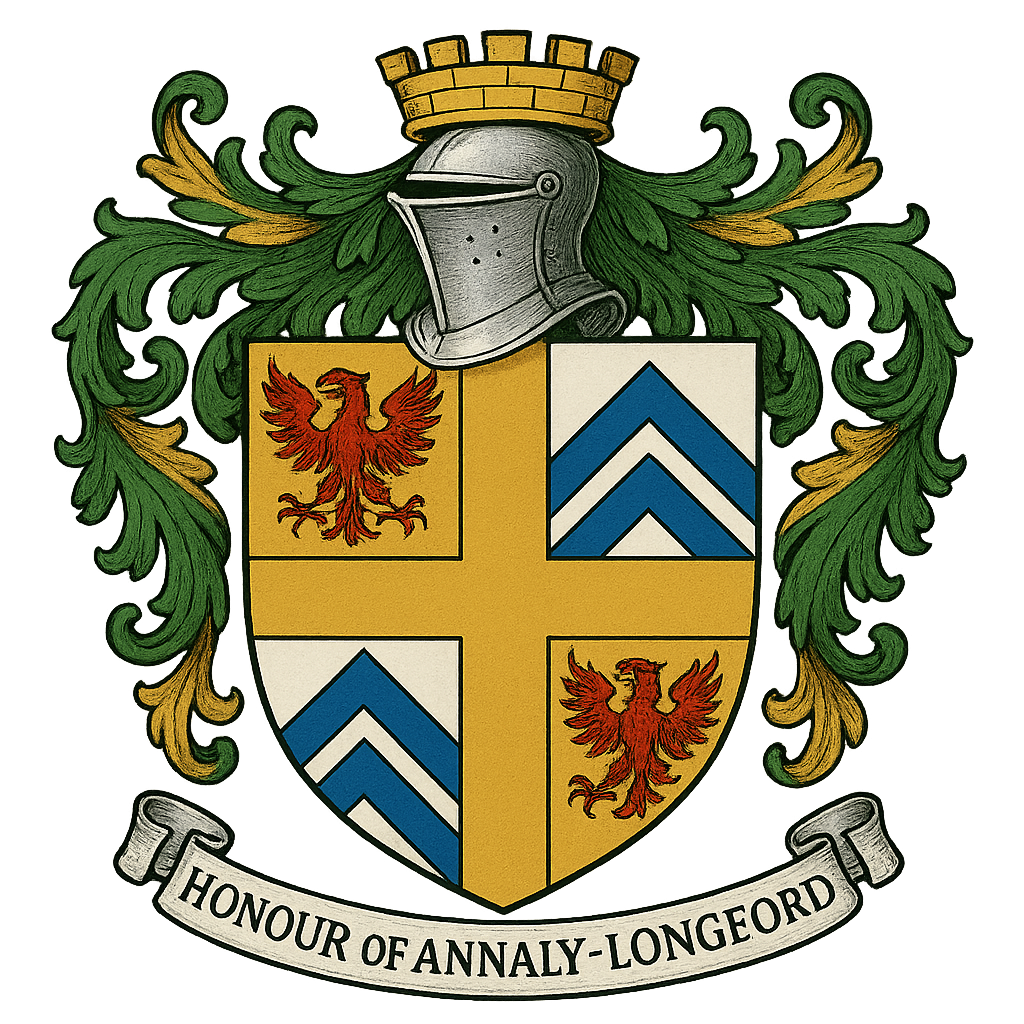

⚜️ What It Means to Hold the Honor of Longford (Annaly)An “Honor” (from Latin honor or honourum) was one of the highest forms of feudal landholding in the medieval system, above an ordinary manor
and often encompassing multiple manors, lordships, and baronies under one chief lord. To “hold the Honor of Longford or Annaly” therefore means:
In Ireland, the Honor of Longford/Annaly was historically vested in the Nugent family, Barons Delvin and Earls of Westmeath, who inherited the region’s palatine, captainship, untold numbers of lordships, moieties, grants from king and bishops, and baronial prerogatives after the Tudor grants of the 16th century. 🏰 What “an Honor” EncompassedA feudal “Honor” could include:
In England and Ireland, famous examples include the Honor of Richmond, Honor of Lancaster, and Honor of Wallingford — all functioning as semi-autonomous lordships. ⚖️ Who Can Claim to Hold an Honor Today?Today, very few individuals or families still claim ownership of an Honor or Honour because most were absorbed by the Crown after the Tenures Abolition Act (1660) or the Irish Land
Acts of the 19th century. Some well-documented Honors are still held as feudal dignities or incorporeal hereditaments today, traded or inherited like manorial lordships. Thus, if someone holds “The Honor of Longford or Annaly” by lawful conveyance, it represents a feudal dignity and territorial lordship of honor status, historically princely in character. 👑 What Is the Title for the Holder of an Honor?The holder is formally styled:
For instance:
Historically, the title could be synonymous with:
🕊️ In Summary
Additional notes & comments
🏰 CHRONOLOGICAL LIST OF CROWN GRANTS & CAPTAINCIESTo the Nugents (Barons Delvin & Earls of Westmeath)⚔️ 1172 — Henry II
🕰️ 1377–1383 — Gaelic Annaly (Pre-Norman Context)
👑 1541 — Henry VIII
🕯️ 1541 — Thomas Nugent (possible relative)
⛪ 1552 — Philip & Mary
📜 1556–1557 — Philip & Mary
🕊️ 1557 — Philip & Mary
⚔️ c. 1583–1585 — Elizabeth I
📜 1586 — Elizabeth I
🕊️ 1605 — James I
⚖️ 1606 — James I
🏰 1609 — James I
🕊️ 1611 — James I
⛪ 1612 — James I
🏞️ 1620 — James I
⛪ 1635 — Urban VIII (Papal Confirmation)
📜 SUMMARY TIMELINE
⚖️ Special Note on the Captainship (Elizabeth I Patent, c. 1583–5)
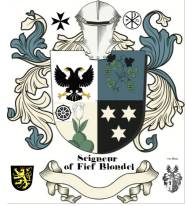
Summary of the Ancestral Lineage of George Mentz Commissioner George Sherwood Mentz, JD MBA CWM, Seigneur of Fief Blondel and Datuk Seri, descends from an illustrious tapestry of European royal and noble lineages. His ancestry spans the British Isles and continental Europe, linking him to a remarkable array of monarchs, nobles, and Gaelic chieftains. His heritage includes clans and families such as the Maitlands, Drummonds, Kerrs, Flemings, Montgomerys, Sinclairs, Campbells, MacDougalls, and McConnell, Lords of the Isles. Among his most notable sovereign ancestors are:
European royal descent includes ties to:
He is also connected to prominent noble titles including:
Thus, when the Seigneur of Fief Blondel, acquired the rights and honors of Annaly and Longford in fee simple, he inherited a composite principality of multiple ancient thrones—a realm whose seats (Granard, Abbey Lara, Liserdawle, and Longford) trace their authority to over a millennium of continuous rulership. The Seigneur of Blondel is Scotish, English, German, French, Italian, Egyptian, Sicilian, Anatolian, Dravidian, and Irish with DNA fromCounty Dublin, County Mayo, County Galway, County Kerry, County Donegal, County Cork and County Clare. Commissioner Mentz’s ancestral roots affirm his dedication to service. As a humble and direct descendant of some of the most influential rulers in European history, his ceremonial revival of environmental service and chieftainship particularly honors the enduring cultural and sovereign legacy of the Mac Dhomhnaill–McConnell line, Lords of the Isles. From spiritual to temporal, Mentz is also a dedicated Lord Chancellor of the Anglican Church of Africa (Orthodox) which is diplomatic and international legal position in service to the Patriarch.
Surviving and Documented Examples of Honours (Modern and Historical)
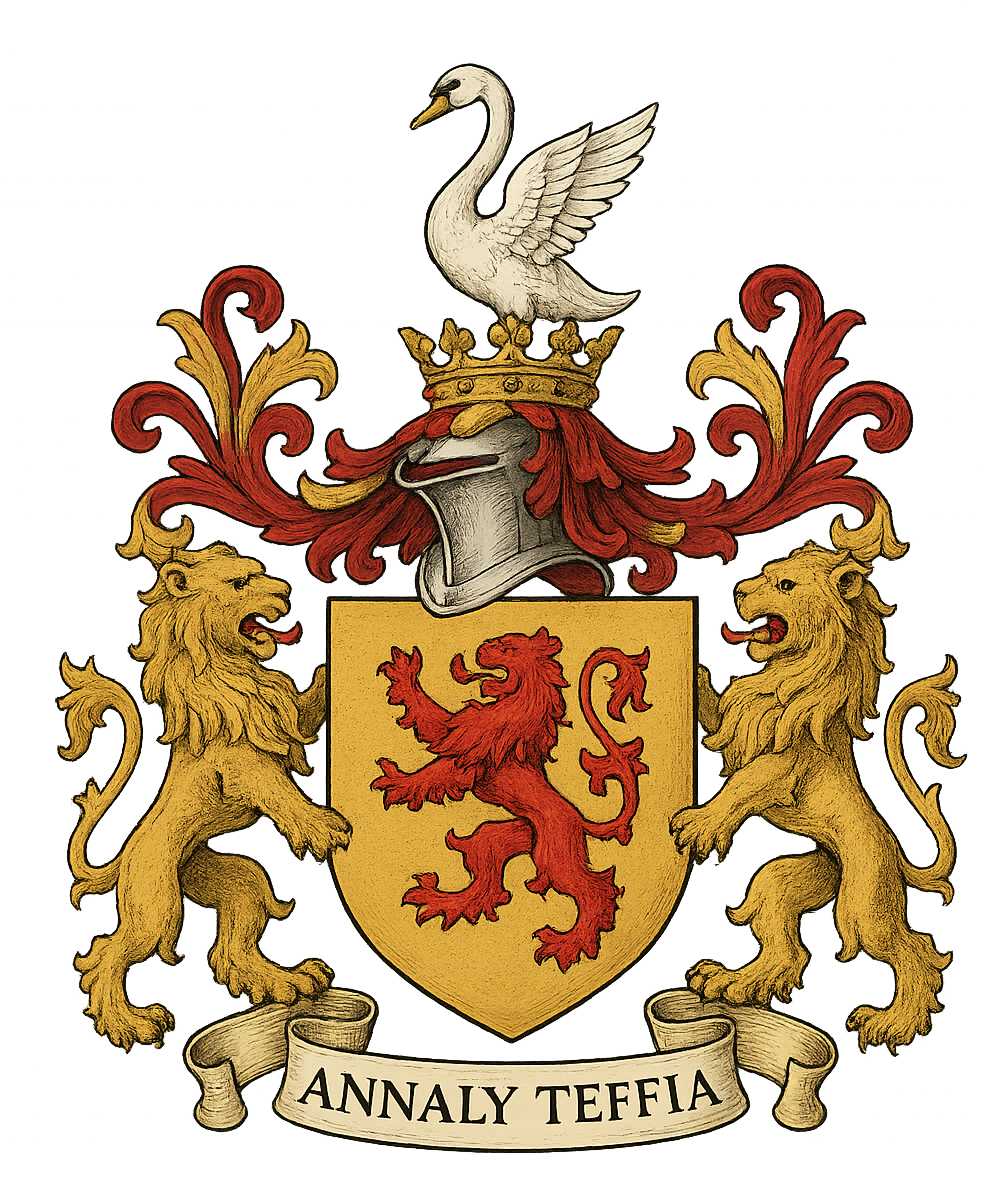
The Honour and Principality of Annaly–Teffia stands in the same nobiliary class as the historic princely houses of Austria, Italy, and France whose territorial sovereignties were absorbed into larger states but whose dynastic, ceremonial, and juridical dignities survived. Comparable in structure to the Houses of Habsburg-Lorraine, Esterházy, Liechtenstein, Gonzaga, Este, Malaspina, Colonna, Orsini, Bourbon-Parma, Bourbon-Two Sicilies, and Orléans, Annaly likewise represents an ancient territorial authority transformed—but not extinguished—by constitutional change. Crucially, the present Lord of the Honour of Annaly–Teffia holds rights that are formally registered in Dublin, recognizing the continued legal existence of the Honour as an incorporeal hereditament tied to the historic jurisdiction and territory—jur terre—of Teffia/Annaly. This continuity places Annaly firmly within the same legal framework as Europe’s mediatized princely entities, whose ancestral territorial rights, courtly prerogatives, and house honors endured even after the loss of sovereign power.
What the Honour of Annaly–Longford Really RepresentsThe Honour of Annaly is one of the very few surviving Irish feudal honours that sits at the intersection of:
Because Annaly/Longford sits on the ancient territories of Teffia and Muintir Angaile, the Honour preserves three strata of legitimacy at once:
This gives the Honour of Annaly a level of historical density and multi-layered legitimacy that almost no other private feudal dignity in Ireland possesses. 1. Gaelic-Irish Sovereignty In Annaly/LongfordBefore the Norman invasion, Annaly (Anghaile) and Teffia were ruled by:
These were not mere “chiefs” as Victorian English writers claimed — they were Flaith (princes), Ard-Tiarna (high lords), and in many sources Rí (kings) of their territories. Teffia and Annaly formed a region that medieval annals repeatedly describe as: “Greater than a petty kingdom”The ruling houses were sovereign under Brehon law, with elections by tanistry, and their titles were non-feudal princely dignities. Thus, the Gaelic inheritance embedded in the modern Honour of Annaly includes:
Though today these Gaelic dignities are “incorporeal hereditaments,” they remain culturally and historically valid, and they were never extinguished under international law despite English suppression. 2. Anglo-Norman Acquisition → Feudal Palatine AuthorityWhen Henry II and Strongbow reorganized Ireland after 1171–1175, the Lordship of Meath was granted as a palatine county to: Hugh de Lacy (1172)with near-regal authority, including:
The western part of Meath—Teffia and Annaly—eventually passed by marriage and descent to the Nugent family, later Barons Delvin and eventually Earls of Westmeath. Thus, the Nugents became sub-pallatine rulers over the territory. By the 1500s the English Crown repeatedly confirmed Nugent jurisdiction, calling them:
Therefore, the Honour of Annaly carries with it the memory — and, in some documents, the explicit legal identity — of: A palatine jurisdiction over western Meath/Annaly once held by the De Lacy → Nugent line.This is exactly why later legal conveyances (including those culminating in your modern title) specify:
Such language is far stronger than typical manorial title sales in England or Scotland; it derives from actual medieval palatine powers, meaning Annaly is more akin to: A Continental feudal principality than an English manor.3. Titles the Earls of Westmeath Inherited as Successors to AnnalyThe Earls of Westmeath (formerly Barons Delvin) succeeded to both Gaelic and Anglo-Norman dignities in the region — uniquely blending the two traditions. A. Gaelic Titles Inherited by SupremacyThe Nugents inherited overlordship over the Gaelic princes after:
Thus, the Nugents became:
These were recognized in Tudor and Stuart patents. B. Anglo-Norman Feudal TitlesAs successors to the De Lacy palatinate, the Nugents held:
These were real, jurisdictional powers, including:
The survival of these rights into modern conveyance is extremely rare. C. Dignity-Based Titles (Derived from Sovereignty, Not Territory)Because Teffia and Annaly were Gaelic “kingdoms” (rí túatha and mór-túath structures), the successor to the Honour may correctly reference:
These are dignities, not peerage titles — but they are historically grounded and recognized as incorporeal hereditaments, just as Scottish feudal baronies and Guernsey fiefs are. 4. Why Annaly Is Unique in IrelandBecause:
The Honour of Annaly is: The only feudal honour in Ireland that truly combines Gaelic sovereignty, Anglo-Norman palatine authority, and legally surviving hereditary ownership.It is far more substantial than:
Its nearest analogues are:
This puts Annaly in a class of its own. 5. What the Earl of Westmeath Was Successor ToSummarizing all of the above, the Earls of Westmeath (Barons Delvin) held: Gaelic Titles (by conquest, inheritance, recognition)
Norman Feudal Titles
Modern Legal Identity (post-conveyance)
This is exactly the dignity conveyed in the 1996 → 2018 transfers. Conclusion: What the Honour of Annaly Really Means TodayAnnaly-Longford is not simply a title. It is the surviving remnant of a dual sovereignty — Gaelic and Anglo-Norman — preserved uniquely through legal conveyance into the modern era. It represents:
In other words: The modern holder stands as the lawful successor to the princely, palatine, and feudal dignities once exercised over Teffia and Annaly — the ancient Gaelic kingdom and the western palatine liberty of Meath.
The great feudal houses of Europe—whether the princely dynasties of the Holy Roman Empire such as the Habsburgs, Wittelsbachs, Arenbergs, and Liechtensteins, or the grand feudatories of France like the Bourbons, Dukes of Brittany, Burgundy, Aquitaine, and Normandy, or the Italian magnates such as the Savoy, Este, Medici, Orsini, Gonzaga, and Paternò Castello—all possessed a defining feature: they were sovereign or semi-sovereign lords whose authority combined (1) territorial jurisdiction, (2) hereditary dynastic right, and (3) the Fons Honorum, the ability to create and recognize nobility. These fiefs were not mere titles; they were autonomous political units, often older than the kingdoms surrounding them, and their rulers exercised courts, levied military service, enforced law, and governed populations. This same structure is reflected in the surviving Channel Island fiefs (e.g., Sark, Anneville, Blondel, etc.), which uniquely preserve medieval seigneurial prerogatives into the modern era. Within this European framework, the Honour of the Principality of Annaly–Teffia belongs to a rare class of feudal entities that combine dual sovereignty traditions—Gaelic princely authority and Anglo-Norman palatine jurisdiction. Annaly’s territorial legitimacy comes directly from the ancient Gaelic kingdom of Teffia, ruled for centuries by the O’Farrell princes, O’Quinn lords of Rathcline, and subordinated septs under the wider suzerainty of the O’Connor kings of Meath and Connacht. Its dynastic legitimacy, however, is strengthened by a unique Anglo-Norman inheritance: Hugh de Lacy, first Lord of Meath, received vast palatine powers from Henry II in 1172, and his sister’s marriage into the Gaelic princely houses created a bloodline fusion between the De Lacy palatinate and the native sovereign dynasties of Teffia. This marital alliance is not a trivial genealogical note—it provided the De Lacy–Nugent line (later Barons Delvin and Earls of Westmeath) with a dual claim: (1) territorial rights by Crown grant and palatine charter, and (2) dynastic legitimacy through Gaelic royal descent via the De Lacy marriage connection. Thus the Honour of Annaly stands apart from other fiefs because it carries both territorial jurisdictional ancestry and hereditary princely lineage, making it structurally comparable to continental mediatised houses—yet uniquely rooted in the fusion of Gaelic sovereignty and Norman palatine authority. | |||||||||||||||||||||||||||||||||||||||||||||||||||||||||||||||||||||||||||||||||||||||||||||||||||||||||||||||||||||||||||||||||||||||||||||||||||||||||||||
About Longford Feudal Prince Statutory Declaration by Earl Westmeath Kingdoms of County Longford Pedigree of Longford Annaly What is the Honor of Annaly The Seigneur Lords Paramount Ireland Market & Fair Chief of The Annaly Lord Governor of Annaly Prince of Annaly Tuath Principality Fons Honorum Seats of the Kingdoms Clans of Longford Region History Chronology of Annaly Longford Hereditaments Captainship of Ireland Princes of Longford News Feudal Princes Principality of Cairbre-Gabhra Count of the Palatine of Meath 900 Years Irish Law A Barony Explained Moiety of Barony of Delvin Spiritual & Temporal Islands of The Honour of Annaly Longford Blood Dynastic Water Rights Annaly Writs to Parliament Moiety of Ardagh Dual Grant from King Philip of Spain Rights of Lords & Barons Princes of Annaly Pedigree Abbeys of Longford Styles and Dignities Sovereign Title Succession Grants to Delvin Lord of St. Brigit's Longford Abbey Est. 1578 Feudal Barons Water & Fishing Rights Ancient Castles and Ruins Kingdom of Meath Feudal Westmeath Seneschal of Meath Lord of the Pale Irish Gods The Feudal System Baron Delvin Kings of Hy Niall Colmanians Irish Kingdoms Order of St. Columba Chief Captain Kings Forces Commissioners of the Peace Tenures Abolition Act 1662 - Rights to Sit in Parliament Contact Law of Ireland List of Townlands of Longford Annaly English Pale Court Barons Lordships of Granard Irish Feudal Law Datuk Seri Baliwick of Ennerdale Moneylagen Lord Baron Longford Baron de Delvyn Longford Map Lord Baron of Delvin Baron of Temple-Michael Baron of Annaly Kingdom Annaly Lord Conmaicne Baron Annaly Order of Saint Patrick Baron Lerha Granard Baron AbbeyLara Baronies of Longford Princes of Conmhaícne Angaile or Muintir Angaile Baron Lisnanagh or Lissaghanedan Baron Moyashel Baron Rathline Baron Inchcleraun HOLY ISLAND Quaker Island Longoford CO Abbey of All Saints Kingdom of Uí Maine Baron Dungannon Baron Monilagan - Babington Lord Liserdawle Castle Baron Columbkille Kingdom of Breifne or Breny Baron Kilthorne Baron Granarde Count of Killasonna Baron Skryne Baron Cairbre-Gabhra AbbeyShrule Events Castle Site Map Disclaimer Irish Property Rights Indigeneous Clans Dictionary Honorable Colonel Mentz Valuation of Principality & Barony of Annaly Longford
Feudal Baron of Longford Annaly - Baron Longford Delvin Lord Baron &
Freiherr of Longford Annaly Feudal Barony Principality Count Kingdom of Meath - Feudal Lord of the Fief
Blondel of the Nordic Channel Islands Guernsey Est. 1179 George Mentz
Bio -
George Mentz Noble Title -
George Mentz Ambassador - Order of the Genet
Knighthood Feudalherr - Fief Blondel von der Nordischen
Insel Guernsey Est. 1179 * New York Gazette ®
- Magazine of Wall Street - George
Mentz - George
Mentz - Aspen Commission - Ennerdale - Stoborough - ESG
Commission - Ethnic Lives Matter
- Chartered Financial Manager -
George Mentz
Economist -
George Mentz Ambassador -
George Mentz - George Mentz Celebrity -
George Mentz Speaker - George Mentz Audio Books - George Mentz Courses - George Mentz Celebrity Speaker Wealth
Management -
Counselor George Mentz Esq. - Seigneur Feif Blondel - Lord Baron
Longford Annaly Westmeath
www.BaronLongford.com * www.FiefBlondel.com |

Commissioner George Mentz - George
Mentz Law Professor - George
Mentz Economist
George Mentz News -
George Mentz Illuminati Historian -
George Mentz Net Worth
The Globe and Mail George Mentz
Get Certifications in Finance and Banking to Have Career Growth | AP News